
Production control
In the electronics industry, quality is not an option – it is a prerequisite. Every cold solder joint, incorrectly selected component, or micro-crack on a PCB track can determine the success or failure of the finished device.
How do we do it at BaZeKo?
At BaZeKo, we understand this responsibility, which is why we have created a quality control system that accompanies the product at every stage: from the receipt of raw materials and components into the warehouse, through PCB production, SMT and THT assembly, quality testing, and warehousing, all the way to final shipment.
Our standards and certificates:

ISO 9001:2015 Certificate
Our quality management system is regularly audited and certified by independent bodies (ISOCERT). For our clients, this is a guarantee that internal company processes are repeatable, transparent, and constantly optimized.
IPC Standards
We carry out all production based on international electronic assembly acceptance standards. We work in accordance with the IPC-A-610 (for assembly) and IPC-A-600 (for PCBs) standards, which allows us to deliver products that meet Class II requirements. IPC-7711B/7721B – Rework, Modification and Repair of Electronic Assemblies (full scope of the standard).


RoHS
RoHS is an EU directive restricting the use of certain hazardous substances in electrical and electronic equipment. In accordance with its guidelines, we use materials that meet its requirements. In a specialized laboratory, the composition of tin alloys is cyclically monitored to ensure compliance with the RoHS directive.
Expert team
Our production team consists of qualified specialists who regularly improve their skills by participating in IPC training to meet the growing technological demands of the industry.


Production and archiving conditions
In departments where environmental parameters have a significant impact on the reproduction of the board design, as well as in the entire assembly department and component warehouse, an air conditioning system has been installed to monitor and maintain the appropriate set environmental parameters.
Supplier verification:
We work exclusively with proven suppliers or manufacturers of both components and production materials. Every batch of material is checked for compliance with documentation and required certificates. We maintain strict supervision over delivered production materials, electronic components, and parts to ensure comprehensive traceability.

Advanced inspection methods
The advanced inspection methods used at BaZeKo ensure high production quality. They allow for precise management of the production process, automatic real-time inspection between individual technological stages, elimination of errors, and logging of process flows.
Inter-operational PCB control
In the printed circuit board manufacturing process, all parameters affecting the quality of the manufactured PCBs are subject to strict control. We control, among other things, the composition and purity of the baths in the metallization process and the photopolymer processing. AOI (Automated Optical Inspection) testers verify design compliance between the various stages of production. An external laboratory checks the composition of tin alloys for compliance with the RoHS directive.
Furthermore, technological documentation is stored in a room with a strictly controlled environment, where the individual stages of the copper pattern reproduction process take place.
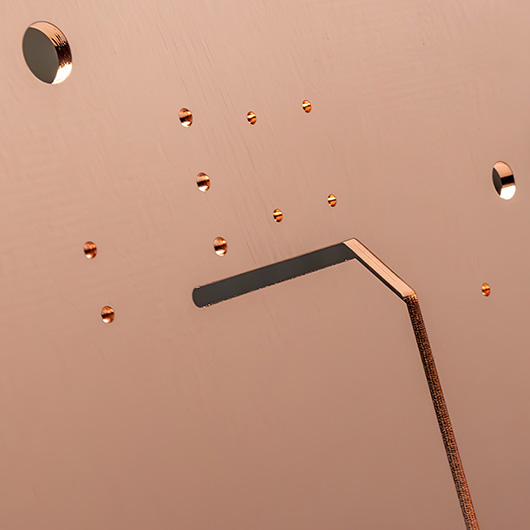
Control of the hole metallization process
The metallization process is subjected to strict control (chemical analysis) on a daily basis. We perform metallization using tenting technology.
Because the copper layer is applied not only to the hole barrels but also to the entire panel surface, the primary layer is prepared very meticulously. The process eliminates any contamination, voids, scratches, and defects between the primary layer and the applied layer. This has a huge impact on the quality of the connection between elements (uniform track thickness).
AOI inspection of bare PCBs
We use AOI (Automated Optical Inspection) testers to control individual stages of printed circuit board production. This allows us to strictly control and eliminate any errors in the technological workflow. Every board undergoes both inter-stage and final inspection. Using data from CAD files, we compare the accuracy of reproducing the client’s design.
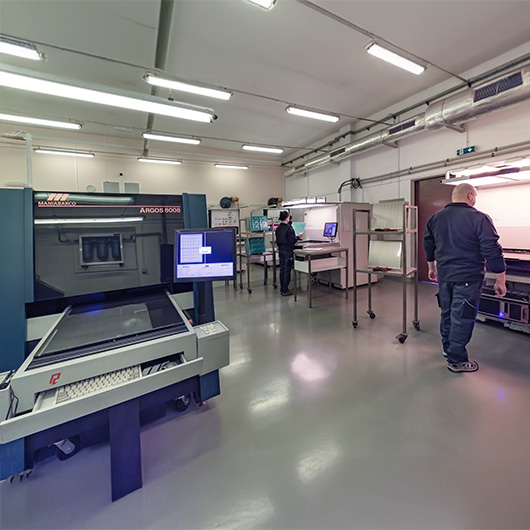
Electrical testing of bare PCBs
Before we hand over the finished boards to the client or for assembly, they undergo an automatic electrical test and visual verification. 100% of the boards are tested for track conductivity and short circuits based on CAD files from the design provided by the client.
Meanwhile, visual verification complements the inspection of the boards in terms of aesthetics.
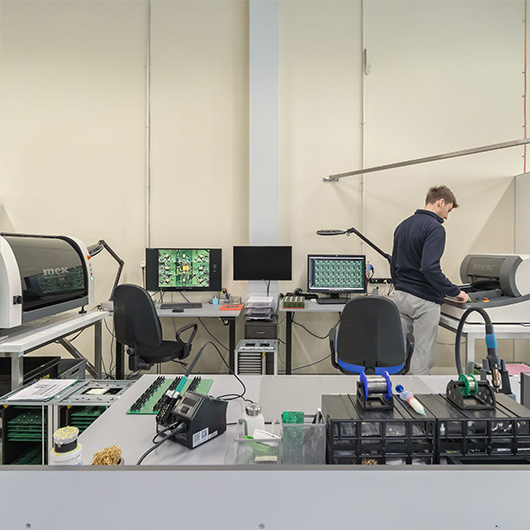
AOI inspection of assembled PCBs
After assembly, 100% of PCBA boards undergo a final inspection for correct assembly. AOI (Automated Optical Inspection) testers perform tests based on CAD files from the design, BOM files, and any technical documentation provided by the client. Based on technical and technological documentation, we use AOI to check for component presence and position, polarity, misalignments, solder shorts, solder joint quality and correctness, component markings, and mechanical damage.
Functional and electrical testing
Based on the technical documentation, samples, and guidelines provided by the client, we can perform final electrical and functional tests.
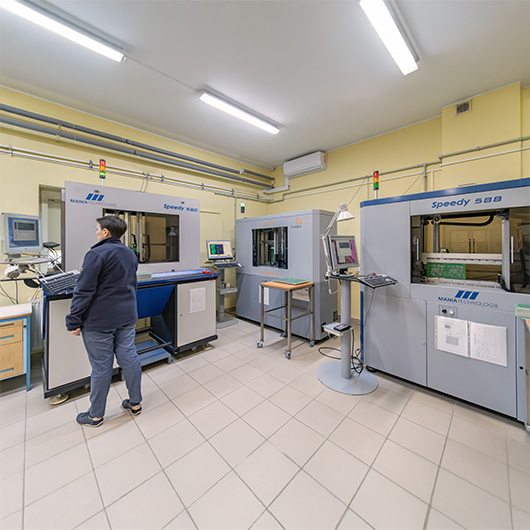
Solder alloy control
Regular laboratory control of tin composition and quality, also in accordance with RoHS guidelines.
Activity logging
Maintaining a log of performed activities for potential backtracking and finding the source of an error.
Inter-stage control
Every production stage ends with checking the product/semi-finished product using appropriate processes.

